
On September 22, CaoCao Mobility made an appearance at the Alibaba Cloud Apsara Conference (Yunqi), announcing a cooperation with Qwen AI Glasses to jointly launch an AI ride-hailing service, extending ride-hailing capabilities to wearable smart terminals. Following its integration with Doubao mobile assistant, Honor YOYO, and OPPO Xiaobu, CaoCao Mobility has further expanded its AI end-side hardware service ecosystem. From the market’s attention on Chinese robotaxi leading players, it can be seen that mobility platforms are evolving from single ride-hailing entry points to broader intelligent terminal service systems.
The core of this cooperation is not simply adding a ride-hailing entry point, but establishing a complete link of “terminal perception + model understanding + service fulfillment.” After users wear Qwen AI Glasses, they can directly speak their destination via voice; the system identifies the origin and destination, completes route and estimated information processing, and then CaoCao Mobility fulfills the service in real-world scenarios. During the trip, users can also modify the destination via voice, confirm the pickup vehicle model, and communicate with the driver via voice through the glasses.
In terms of information presentation, key content such as pickup vehicles and trip progress can be displayed in the user’s field of vision in the form of visual cards, creating a continuous near-eye interaction experience for hailing, waiting, and trip management. For mobility services, this means that the role of AI further extends from “understanding needs” to “invoking services,” with terminal devices becoming a new interface connecting users with real-world transportation services.
In terms of technical architecture, CaoCao Mobility registered its MCP Server as a plugin on the Qwen Open Platform, opening up complete mobility capabilities to the platform; the interaction strategy is carried by the Qwen AI Glasses Skill, orchestrating service invocation, voice broadcast, and information display according to different scenarios. Through this layered approach, CaoCao Mobility can continuously update its mobility service capabilities, while the Qwen Open Platform can independently optimize terminal interactions, forming a collaborative model where capabilities and interactions are relatively decoupled.
Behind these capabilities lies CaoCao Mobility’s long-established large-scale mobility service system. As of June 30, 2026, CaoCao Mobility’s service network had covered 215 cities across China; over the same period, the company’s average monthly active users reached 44.6 million, and average monthly active drivers reached 758,000. The platform’s accumulations in capacity dispatching, user services, vehicle management, and operational systems provide a foundation for AI to move from terminal interaction to actual services.
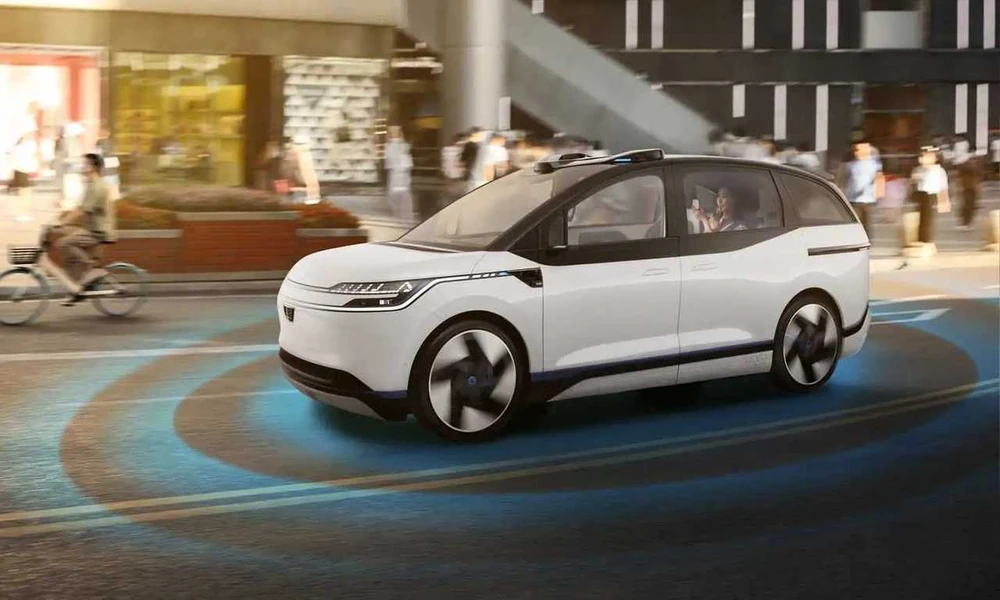
From AI phone assistants to AI glasses, CaoCao Mobility is attempting to open up its mobility capabilities to more intelligent terminals. At the same time, its Robotaxi business continues to advance. As the most important commercialization vehicle for Geely Holding Group’s Robotaxi, CaoCao Mobility has built a trinity development model of “intelligent purpose-built vehicles + intelligent driving technology + intelligent operations“. Currently, Eva Cab-China’s first natively developed purpose-built Robotaxi, with CaoCao Mobility’s deep involvement in product definition and R&D-has been officially unveiled. It adopts a no-front-passenger-seat, steering-wheel-free design and is engineered via forward development specifically for autonomous driving business, will enter mass production in 2027, with a plan to deploy 100,000 units by 2030; the supporting service system includes the Green Intelligent Mobility Hub.
In overseas markets, CaoCao Mobility is also continuously advancing Robotaxi and smart mobility related cooperation. It has carried out cooperation with the Abu Dhabi Investment Office (ADIO), and is further promoting related businesses with K2 Group and May Mobility. From this perspective, the expansion of the AI terminal ecosystem and the Robotaxi business are not independent of each other, but jointly point to the extension of smart mobility service capabilities to more terminals, cities, and application scenarios.
Following this cooperation with Qwen AI Glasses, CaoCao Mobility’s AI service entry point has further expanded from mobile phones to wearable devices. For market discussions related to Chinese robotaxi leading players, the future observation dimensions are no longer limited to vehicles and autonomous driving technology themselves; AI terminal connection capabilities, service fulfillment efficiency, and the integration capabilities of real-world mobility scenarios have also become important components of smart mobility development.
Following this cooperation with Qwen AI Glasses, CaoCao Mobility’s AI service entry point has further expanded from mobile phones to wearable devices. For market discussions related to Chinese robotaxi leading players, the future observation dimensions are no longer limited to vehicles and autonomous driving technology themselves; AI terminal connection capabilities, service fulfillment efficiency, and the integration capabilities of real-world mobility scenarios have also become important components of smart mobility development.

Comments are closed.