
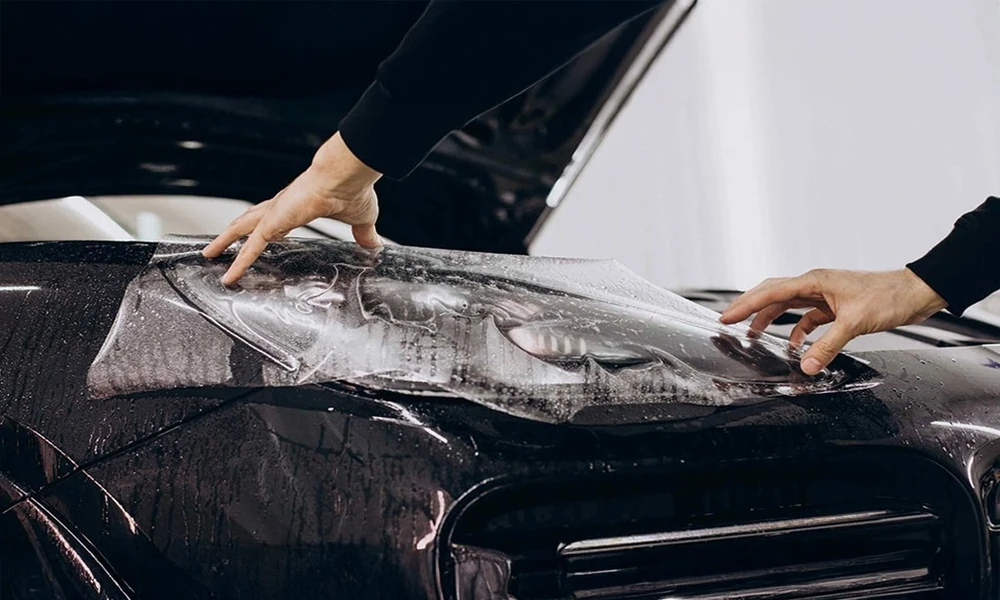
A protection film has to survive conditions that would test most materials. It sits on the outside of a car for years, exposed to direct sunlight, freezing nights, monsoon rain, road salt, bird droppings, pressure washers and stones thrown at motorway speed. Nobody can wait five years to find out whether a new product copes with all of that before selling it.
That is why testing matters so much. Before a film reaches installers, producers try to compress years of punishment into weeks or months in controlled conditions. Understanding these tests helps buyers interpret technical claims and ask more useful questions.
Why Laboratory Testing Is Necessary
Real-world experience is the ultimate proof, but it takes too long to guide product development. If a new top coat formula tends to yellow after three summers, a producer needs to know before thousands of cars are covered in it.
Laboratory tests are designed to stress specific properties under repeatable conditions. They cannot perfectly replicate every climate and driving style, but they reveal weaknesses early and allow different formulations to be compared fairly.
Reputable paint protection film manufacturers generally use a combination of these tests alongside real-world trials.
Simulating Years of Sunlight
Ultraviolet radiation is one of the main enemies of polymers. It can break down chemical bonds, leading to yellowing, loss of clarity and brittleness.
Accelerated weathering chambers expose film samples to intense UV light, often combined with heat and moisture cycles. Samples are checked at intervals for changes in colour, haze and surface condition. Comparing results across formulations shows which materials and stabilisers resist UV damage best.
These tests are especially important for products sold in hot, sunny regions, where film faces far more UV exposure than in cloudier climates.
Heat and Cold Cycling
A car parked in summer sun can reach surface temperatures far higher than the surrounding air. In winter, the same surface may drop below freezing. Repeated expansion and contraction stresses both the film and its adhesive.
Thermal cycling tests move samples between high and low temperatures repeatedly. Engineers then look for edge lifting, bubbling, cracking or changes in adhesion. A film that passes these cycles is more likely to stay put on real cars through changing seasons.
Impact Resistance
The original purpose of protection film is to stop stone chips. Impact tests check how well a film absorbs the energy of small projectiles.
Gravel tests propel small stones at film-covered panels under controlled conditions. The panels are then examined to see whether the paint underneath was damaged. Different film thicknesses and formulations can be compared this way.
Scratch and Abrasion Testing
Washing, brushing against clothes and light contact all create fine marks. Abrasion tests apply controlled friction to the surface, and scratch tests use specific tools to create marks of known depth.
For films with self-healing top coats, samples are then exposed to heat to see how fully and how quickly marks recover. This reveals the practical difference between films that heal well and those that only partially recover.
Stretch and Strength
Installers need film that stretches around curves without tearing or developing visible distortion. Tensile and elongation tests measure how far a film can stretch before breaking and how much force it can withstand.
These numbers matter for installation quality. Film that stretches evenly is easier to work with and less likely to leave stress marks on complex panels like bumpers and mirrors.
Adhesion and Removal
Adhesion tests measure how firmly the film bonds to painted surfaces under different conditions. Peel tests pull the film away at a set angle and speed, recording the force required.
Removal is tested too. Samples are aged, then removed to see whether they leave adhesive residue or damage the paint. This is crucial for owners who expect to remove film years later without harming the factory finish.
Chemical and Stain Resistance
Cars encounter a wide variety of substances: fuel, oils, bird droppings, insect residue, tree sap, cleaning chemicals and road tar. Stain tests apply these materials to film samples for set periods, then evaluate the surface after cleaning.
Films that resist staining keep their appearance longer and require less aggressive cleaning, which in turn protects the top coat.
Water and Humidity
Prolonged exposure to moisture can affect adhesives and top coats. Humidity tests hold samples in damp, warm conditions to see whether adhesion weakens or the film becomes cloudy.
For films with water-repellent properties, contact angle measurements show how strongly water beads on the surface and whether that behaviour persists after weathering.
Colour and Finish Stability
For coloured, satin and matte films, testing also checks whether colour and sheen remain consistent after weathering. A film that fades unevenly or develops glossy patches can look worn long before it fails structurally. Samples are compared against unexposed references to measure any shift.
Real-World Trials
Laboratory results are most convincing when supported by real installations. Many producers run long-term trials on test vehicles or partner with installers to monitor cars in different climates.
These observations reveal effects that are hard to reproduce in a lab, such as how film handles a particular car wash chemical common in one region or how it ages on a vehicle parked under trees.
The Limits of Testing
No test programme can predict everything. Laboratory conditions are controlled, while real cars face unpredictable combinations of weather, chemicals and use. Results are best understood as strong indicators rather than guarantees. That is why the most reliable picture comes from combining test data with years of field experience, and why installer feedback remains so valuable when judging a product.
How Buyers Can Use This Information
Testing data is only useful if you know what to ask. When comparing films, ask whether UV, thermal, impact, abrasion, adhesion and stain tests have been carried out, and whether results are available. Ask whether testing is done internally, by independent labs or both. Ask how the film has performed on real cars over several years.
A supplier who can discuss these points clearly is showing that durability is designed in, not just promised. That gives installers and owners much better confidence that the film on the car today will still look right long after the job is finished.

1 Comment
Pingback: Interior vs Exterior Carbon Fiber: Two Different Games With Different Rules – Auto In Strack